
REI 45 Means Nothing Until You Read the Fire Resistance Report

In short: REI 45 describes one tested assembly, at one thickness, under one applied load. Printed without those conditions, the class is decoration.
Building control, the insurer and the lender all ask the same thing about the external wall: what is its fire resistance class? What comes back is a line on a brochure page. The document that actually answers the question is the fire resistance report sitting behind that line, and it repays ten minutes of reading, because everything useful in it lives in the conditions rather than in the number.
"REI 45 just means the wall stays standing for 45 minutes"
It means more than standing, and it says nothing about the building around the wall. R, E and I are three separate criteria, measured on a specimen in a furnace heated along a standard temperature curve. The minutes are simply the time for which every claimed criterion was still being met.
- R is load-bearing capacity. The specimen kept carrying the load applied to it, within defined limits on how far it deflected and on how fast that deflection was growing.
- E is integrity. No flames or hot gases found a way through cracks, gaps or joints to the unexposed side. The laboratory checks this with gap gauges and a cotton pad held against the surface.
- I is insulation. The temperature on the unexposed face stayed below defined limits, which is how the test judges whether the wall would set fire to whatever is stacked against it in the next room.
Verdict: half true, and the letters do the work. A non-loadbearing partition is classified EI because it has no load to lose. A wall classified REI was carrying load the whole time it burned. Those are not the same product, whatever the minutes say.
"Wood burns, so a solid timber wall cannot hold a real classification"
Solid timber walls are classified routinely, and the reason is dull rather than clever: burning timber behaves in a way that can be measured. The exposed face turns to char at a rate that is broadly predictable, the char layer insulates the timber behind it, and a residual cross-section stays cool enough to keep much of its strength while the fire runs its course.
That residual section is what holds R. It is also why a heavy timber element tends to fail slowly and visibly. Unprotected steel offers no such warning; it loses strength as its temperature climbs and looks much the same while it does it.
None of which means the timber alone decides the result. Joints between panels, fixings, service penetrations and any lining board were all part of the assembly the laboratory built, and in solid timber houses the wall is one component of a fire strategy that also covers detection, escape routes, compartmentation and the roof. For laminated members the adhesive comes up in every conversation, and what the glue line does when a laminated beam is exposed to fire is a subject of its own.
"A thicker wall always gives a better class"
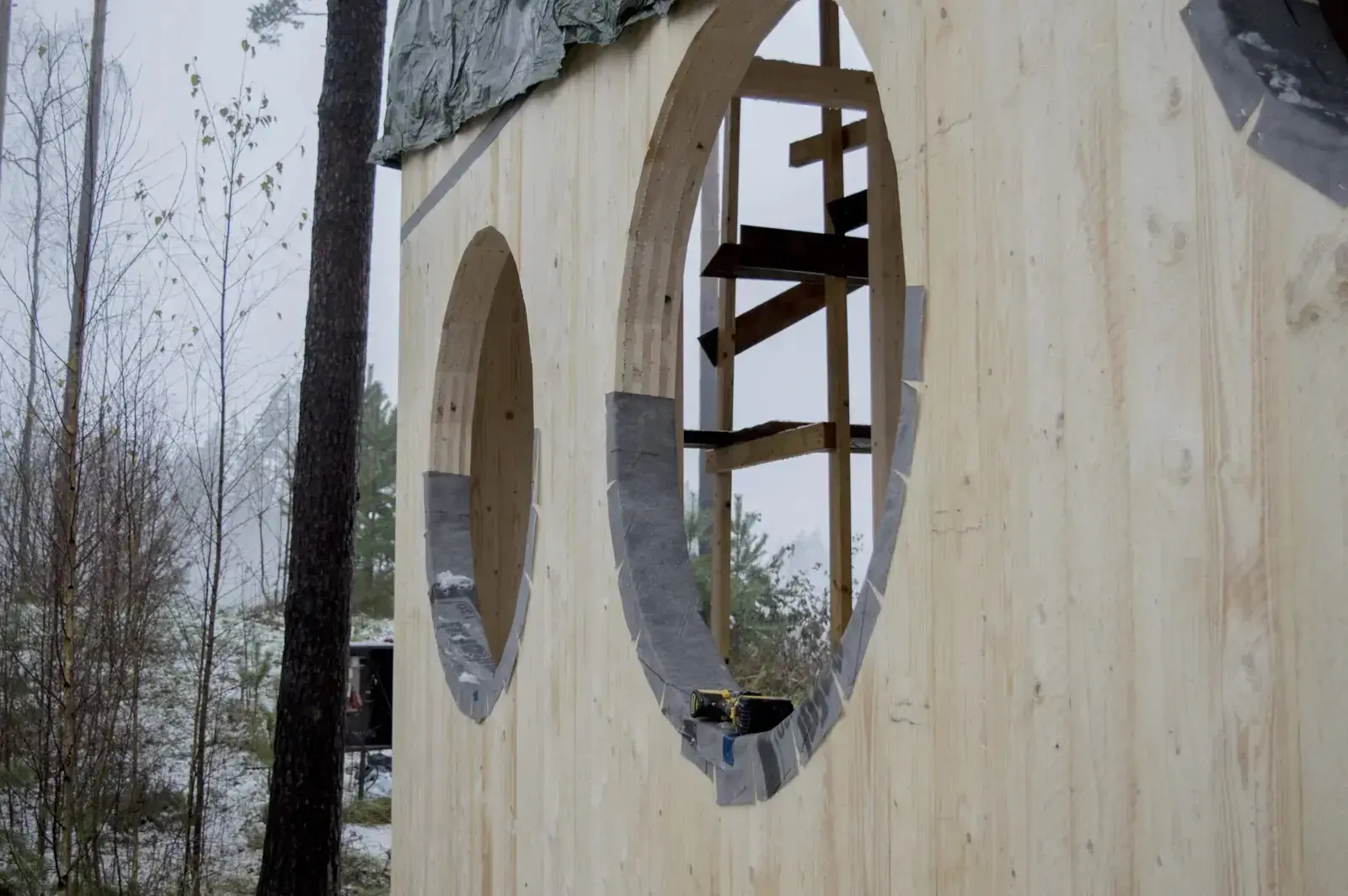
Thickness means nothing until you know what the wall was carrying. R is the criterion for load-bearing capacity, so a specimen tested with no load applied cannot claim R at all. Two walls of identical thickness, tested under different loads, are two different results with two different reports.
The reason is mechanical. As char eats into the section, the timber that is left has to carry the same load through a smaller cross-section, and a lightly loaded wall has more reserve to give away than a heavily loaded one of the same thickness. That is why any classification worth quoting is written as a pair: the build-up and the load, together, in one line.
Layer count and orientation belong in the same line. A five-layer panel and a three-layer panel of similar overall thickness are not the same specimen. Nor are two walls whose panel joints and fixings differ, even if the thickness on the drawing matches to the millimetre.
Verdict: thickness is half a sentence. Ask for the other half.
"The fire resistance report is just paperwork for the permit"
The report is the only place where the class is attached to a described object. We do not run fire tests ourselves, and no manufacturer should: the test belongs in an accredited laboratory, which is the entire point of the exercise. What you are reading is their account of what they built, how they loaded it, how they burned it, and the moment each criterion stopped being satisfied.
The lines that decide whether the report covers your wall
- The overall thickness of the specimen, as a figure, not as a range.
- The layer build-up: how many layers, and which way each one runs.
- Which face was turned towards the furnace.
- The load applied to the specimen during the test.
- Whether the specimen carried a lining board or cladding. If the tested wall had a gypsum lining and yours will not, the class belongs to the lined wall, not to the one on your drawing.
A line worth quoting looks like this: a 112 mm five-layer solid timber wall, REI 45, tested under a load of 30 kN/m in an accredited laboratory. On its own, "REI 45" is a fragment. With the thickness, the layer count and the applied load beside it, an engineer or a building control officer can check it, compare it and use it.
Verdict: the number is the headline, the conditions are the content. And a supplier who can put the report in your inbox the same day has been asked before.
"One test result covers everything the supplier makes"
A classification belongs to the tested build-up and to a defined field of application drawn around it. Test standards do allow results to be extended to closely related constructions, under written rules, but that extension is a documented technical judgement. It is not something a sales department decides, and it has to be traceable back to the same report.
So a class earned by one wall thickness does not travel freely to another. A wall result says nothing about a floor, a roof or a compartment door either. Each of those is tested and classified separately, because each of them fails in a different way and at a different moment.
Then there is the question of what your plot demands. National building regulations set which class is required for which element, in which building, at which size and use, and those requirements are not uniform across Europe. The report tells you what the wall did in a furnace. Your local rules tell you what the wall has to do where it will actually stand.
Verdict: ask which report covers the specific panel on your drawing, then read the field of application at the back of it. That is where the surprises live.
"If the class is on the datasheet, the comparison is done"
Two offers can print the same three letters and the same minutes and still describe walls that have very little in common. One may have been tested at a thickness you are not buying. Another under a load lighter than the one your roof and your snow will apply. A third with a lining that appears nowhere in your specification.
Take a family comparing kit offers for a year-round house. The class shows up on both datasheets, so it cancels out in their heads, drops out of the comparison, and the price gap gets blamed on windows or delivery. Ask both suppliers for the report, the tested thickness and the applied load, and you stop comparing leaflets and start comparing walls.
It is the same discipline the rest of the offer deserves, where the useful move is to make every supplier answer the same questions line by line instead of comparing the totals at the bottom of the page.
Verdict: a class without its conditions is a claim about nothing in particular. With them, it becomes a specification you can hold someone to.
Key takeaway: Ask for three things and read them together: the test report, the tested wall thickness, and the load applied during the test.