Class E insulation does not decide a wall's fire rating
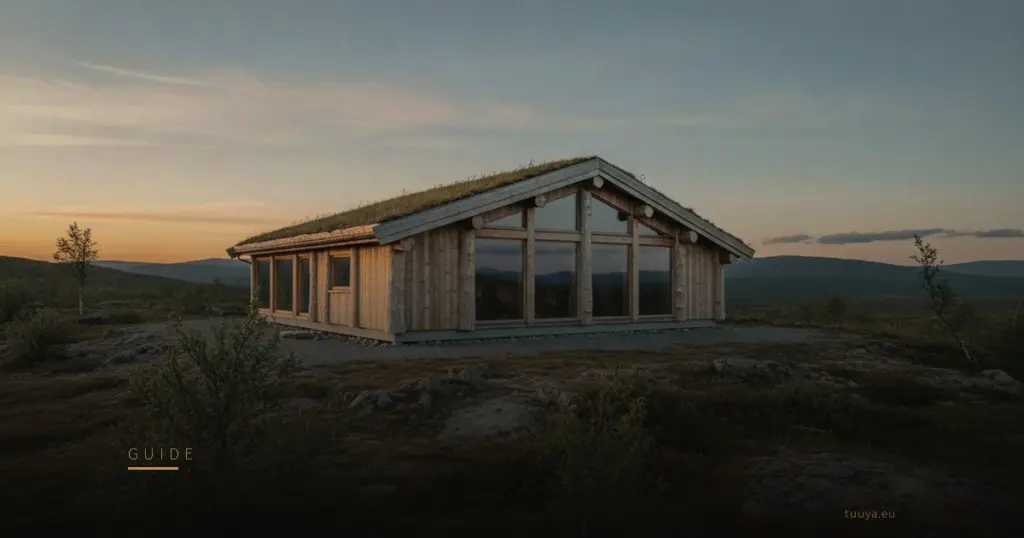
One claim turns up on almost every timber project, usually from a well-meaning relative: wood-fibre boards are dense and natural, so they hardly burn. The opposite claim arrives just as often. Combustible insulation, the story goes, turns a wall into kindling. Both get wrong how a wall is actually judged in a fire. The wood-fibre board in our standard wall is Class E insulation. It is combustible and it chars. A wall with such a board in it can still carry a fire resistance rating, provided the whole assembly was designed and tested for that rating.
We manufacture solid timber houses in Latvia, and our walls are combustible from the core outward. Read what follows with that interest in mind. Where mineral wool is the better call, we say so.
"Wood-fibre insulation is natural, so it barely burns"
It burns. Many wood-fibre boards, ours included, are classified E for reaction to fire under EN 13501-1, the European system that grades how a construction product contributes to the early stages of a fire, on a scale running from A1 down to F.
A1 means the product adds essentially nothing to a fire. Class E means the product met the criteria of a small-flame test. It is still combustible: once a fire is established, it is fuel. And the letter says nothing about how long a wall then lasts.
What wood-fibre does well is char. Heat turns its surface into a carbon layer that can shield the material behind it and slow the burn. Unlike a structural timber member, though, an insulation board is not designed around the section its char leaves behind. Slower burning is still burning.
Like other cellulose-based materials, wood-fibre can also smoulder. Penetrations, service voids and junctions need deliberate detailing for that reason, and because they are where a fire can get past the protective layers. The accurate word for a Class E board is combustible. A supplier who calls a wood-fibre insulation board non-combustible has handed you a good reason to check the rest of the specification.
"Class E insulation turns the whole wall into a fire risk"
The class of one layer does not settle the fire risk of a wall. Reaction to fire and fire resistance answer two different questions. The first is about how a material behaves as fuel when flame first reaches it. The second is about how long a complete wall keeps doing its job while a standard fire attacks one side.
For a load-bearing separating wall, fire resistance is written as REI followed by a number of minutes (an element with a narrower job carries fewer of the letters):
- R is load-bearing capacity, whether the wall keeps carrying its load.
- E is integrity, whether flames and hot gases stay on the fire side.
- I is insulation, whether the temperature rise on the unexposed face stays within the limit.
Those minutes belong to the tested build, at its thickness and under its load, or to a variation inside the field of application stated in its classification report. Before you compare two walls on paper, it pays to know how to read a fire resistance report, because two numbers that look alike can describe very different constructions.
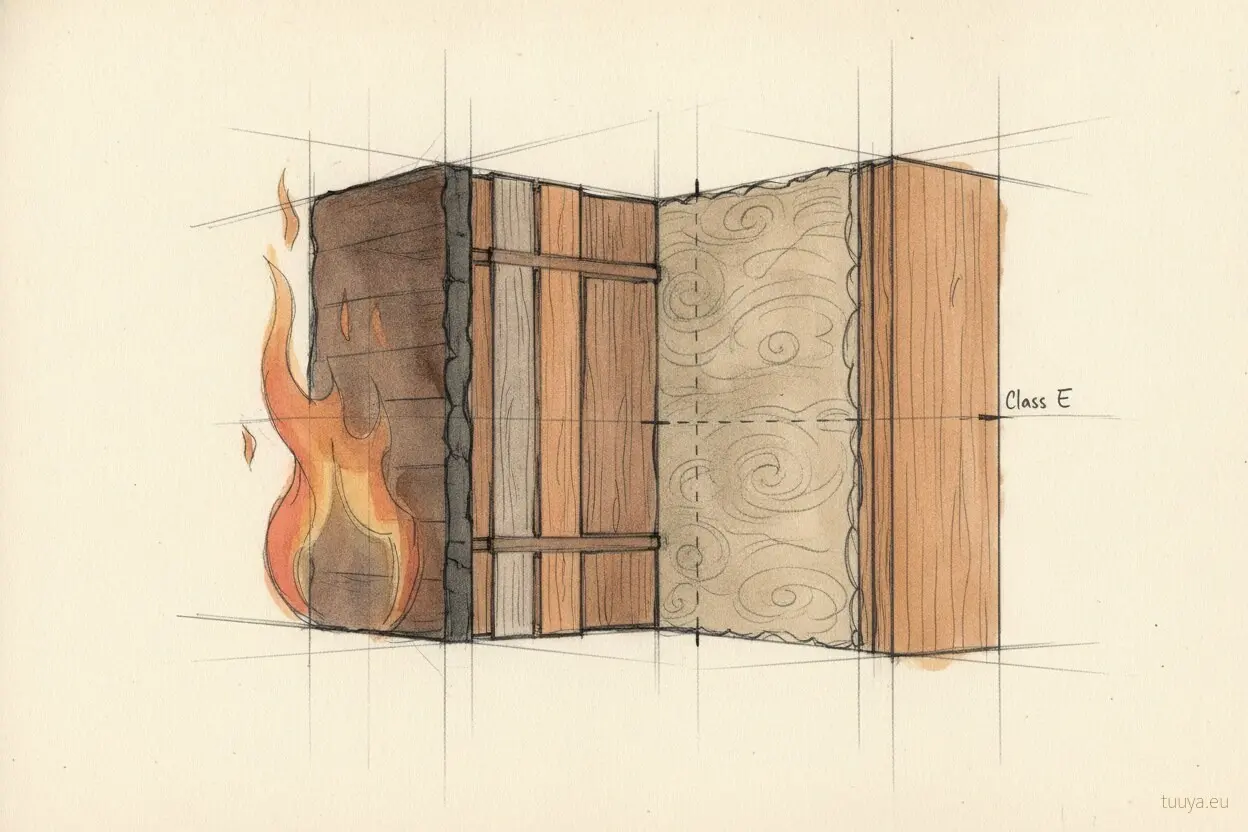
Position matters. Where a solid timber wall is insulated on the outside, a fire in the room meets the lining and the timber before it ever reaches the insulation. That position was not picked for fire alone; the order of the layers in the wall is set by heat and moisture as much as by fire.
From outside, the question moves to the cladding, the ventilated cavity and any cavity barriers; the insulation class alone does not settle how that facade behaves. National rules can treat facades separately, and more strictly for taller buildings or tight plot boundaries. That part gets checked against local requirements for the specific building.
A layer of Class E insulation is a reason to ask for the test evidence of the whole assembly. On its own it tells you very little about how the finished wall performs.
"Mineral wool is A1, so it is always the safer choice"
As a material, yes, mineral wool is safer in reaction-to-fire terms, and that advantage is real. Glass and stone wool without facings can be classified A1, the non-combustible end of the scale.
But a material class describes a product, and a wall is several products held together. Facings, foils and adhesives can change the class of what actually arrives on site. In a fire resistance test, the rating then depends on how the parts behave together:
- whether the insulation stays in place as the wall heats up,
- whether the lining holds,
- how the structural timber chars once it is exposed.
Combustible insulation does not in itself stop an assembly from earning a fire resistance classification: timber is combustible too, and timber walls are classified. What it takes is evidence for one specific build-up of lining, structure, fixings and insulation. That combination is the only level at which two walls can be compared fairly.
Where we would specify mineral wool ourselves
Mineral wool is the sensible specification in these cases:
- a national rule requires non-combustible insulation, which some countries do for certain building heights, uses or facade types;
- the wall runs close to a chimney or flue, though the required clearances and a tested penetration detail still apply;
- the client simply wants the lowest possible fuel load in the wall.
People choose wood-fibre for reasons that have nothing to do with fire. Its vapour permeability suits a vapour-open build-up. It buffers moisture. Its density helps with airborne sound. Those are fair reasons, but only once the fire evidence for the assembly stands up without them.
"Plasterboard gives you a fixed number of fire minutes"
Plasterboard buys time for whatever sits behind it, and how much time depends on the build it is fixed to. Gypsum holds chemically bound water. In a fire that water is driven off as steam, which slows the temperature rise behind the board.
Fire-rated boards can contain glass fibres and other additives that help the core hold together after the water has gone. Once a board cracks, opens at the joints or falls away, the timber and insulation behind it are exposed. Charring starts, or speeds up.
How long the board stays useful depends on several things at once:
- board type and thickness,
- the number of layers,
- fixing type and spacing,
- how the joints are treated,
- the framing or timber behind it.
A protective time on a datasheet applies to the configuration it was measured in. It carries over to another wall only when the documents for that wall say it does.
Solid timber walls can be lined on the room side, or the timber can be left exposed. Where it is exposed, its charring becomes part of the structural fire design. Whether to line a wall is a call for the designer and the fire evidence, and taste comes second.
"Foam insulation and wood-fibre behave the same in a fire"
Two insulation materials can share a Euroclass and behave very differently once they are hot. EPS boards with a Class E rating carry the same letter as wood-fibre. EPS, though, is a thermoplastic: heated, it softens and shrinks back, and it can melt before it ignites.
PIR boards are declared in different classes depending on formulation and facings. PIR is a thermoset, so it chars rather than melts.
Wood-fibre chars too, and it can smoulder. All three produce smoke when they burn. Class E carries no smoke grade, so a bare E on a datasheet tells you nothing about smoke and little about burning droplets.
So a shared letter is no shortcut. Ask how each material behaves at joints, openings and service penetrations in the tested wall. Those are the routes a fire can take through a wall.
"Once a wall has a rating, the insulation can be swapped"
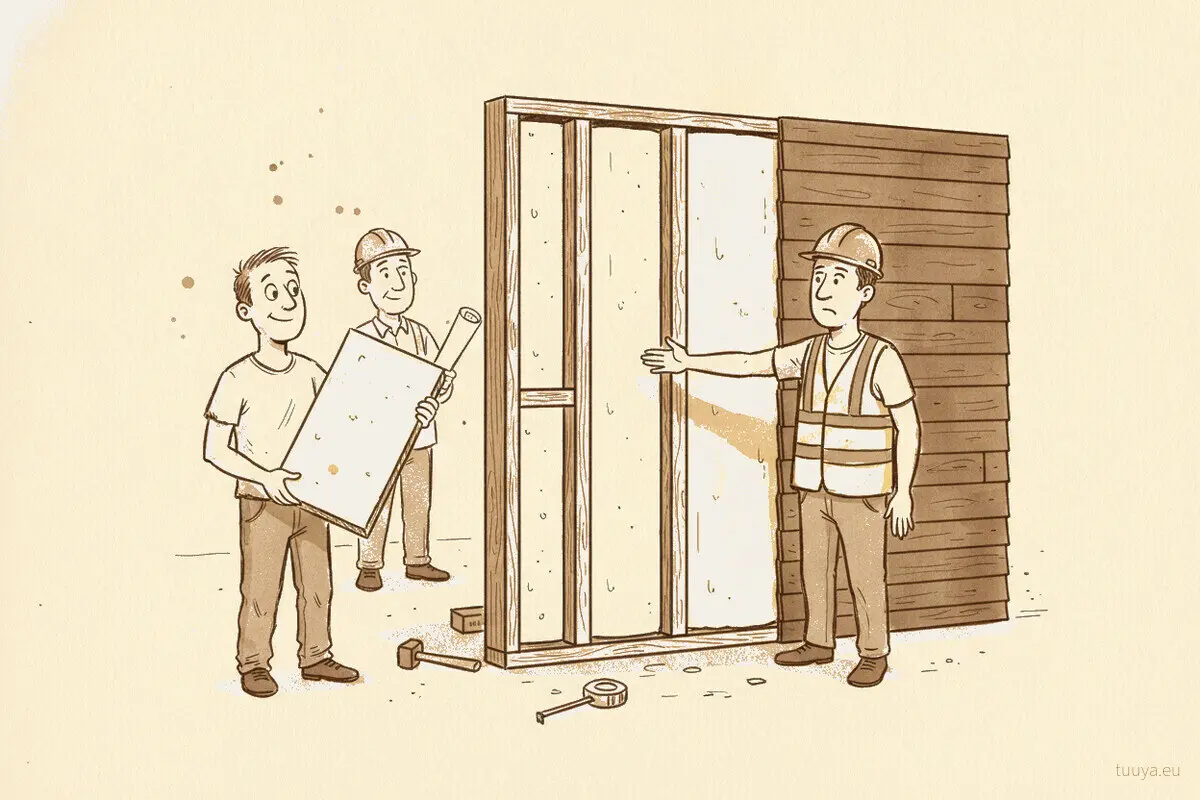
It cannot, at least not freely. A fire resistance rating belongs to the configuration that was tested or formally assessed. Change the insulation, the lining or the fixings and the wall can fall outside it. That cuts both ways.
Swapping Class E insulation for an A1 product feels like an upgrade. A different density, a different shrinkage behaviour or a different fixing pattern can still change how the lining and the structure perform together. Whether the change is covered depends on the field of application in the classification report. Outside it, the change needs evidence of its own; a fire engineer's opinion alone does not extend a classification.
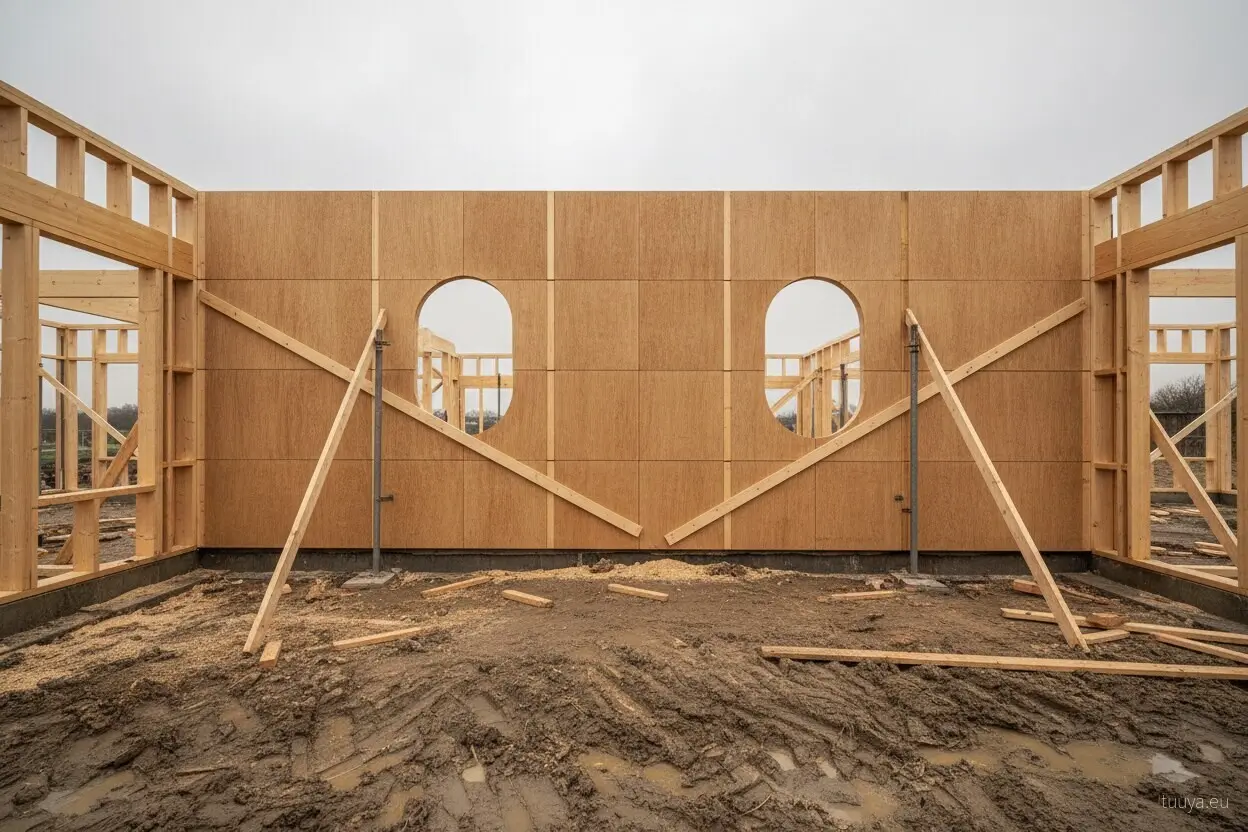
Here is how it tends to happen. A family building a year-round home is offered a cheaper insulation board late in the job, described as the same class. The class may well match. What matters is whether the fire evidence for their wall covers that board. When a substitution like this comes up, work through it in order:
- Find the test report or assessment that covers your wall.
- Check whether it names the proposed board, or covers it within its field of application.
- If it does neither, ask a fire engineer which assessment route your national rules accept, and complete it before the board is installed.
- Record who signed off the change, and keep it with the building file.
The same check applies to sockets, ducts and flue penetrations added after the drawings were frozen. An opening in a lining does not cancel a rating as such, provided it follows a tested or assessed detail.
The file to keep is the fire evidence for your exact wall, checked against the insulation, lining, fixings and penetrations on your drawing.