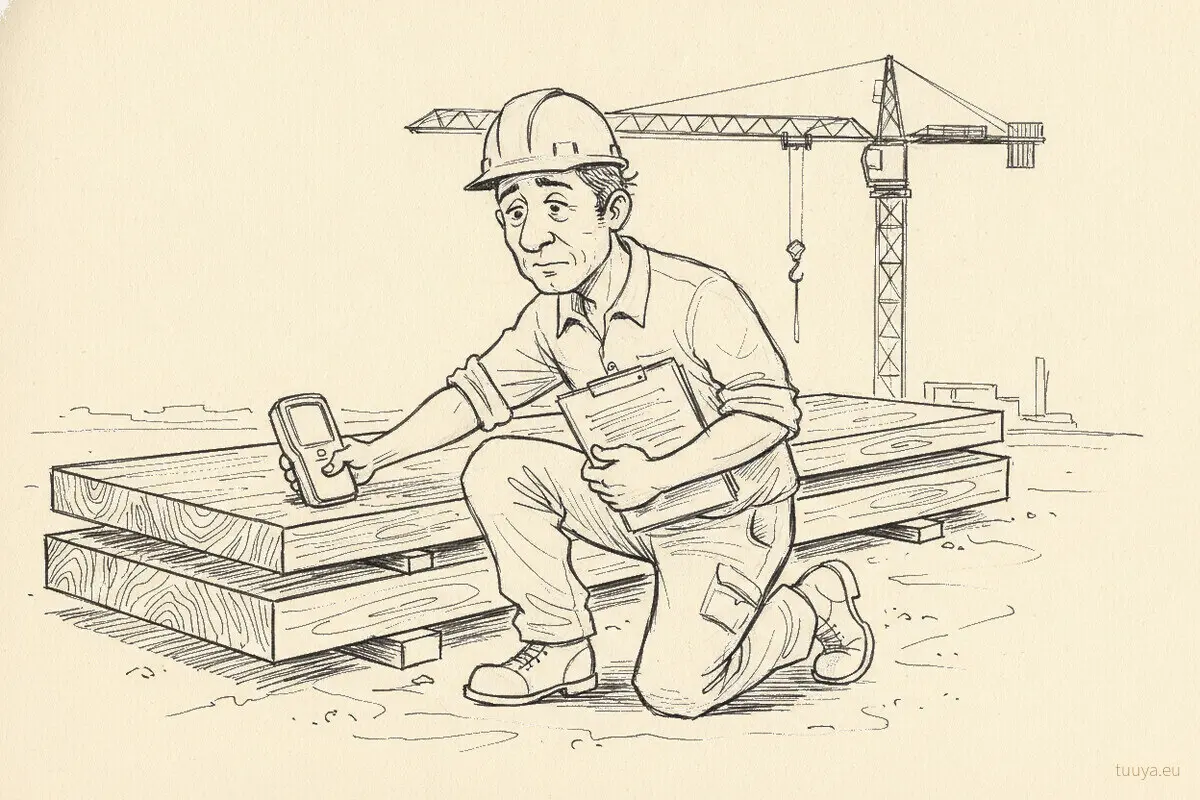
Timber moisture content is only useful with its stage named

A delivery note says 15%, a site reading says 11%, and the manufacturer's datasheet gives a tolerance band that seems to match neither. All three can be right. Timber moisture content changes between the sawmill, the factory and the site, and a figure means nothing until you know where along that line it was taken.
Timber moisture content, stage by stage
These are reference values for a solid timber supply chain, with light framing alongside for comparison. Whether a specific delivery is accepted is decided by the structural design and the supply contract, not by this table.
| Parameter | Figure | What the figure describes |
|---|---|---|
| Incoming sawn timber | About 15%, ±2 to 3 points | Timber as it arrives from the supplier, checked with a moisture meter on intake |
| Finished solid timber panel | In the region of 10 to 12% | The panel as it leaves production, after processing has brought the moisture down |
| MHM timber, manufacturer data | 15% ±3 | Specification tolerance stated in the manufacturer's documentation |
| CLT, manufacturer data | 12% ±2 | Specification tolerance stated in the manufacturer's documentation |
| Light framing, general guidance | Below 16% | Rule of thumb quoted in general building guidance, measured with a moisture meter |
| Erected frame on a timber-frame site | Not measured by default | Worth requesting when the frame has been rained on before the shell is closed |
| Moisture at which decay starts | No single threshold | Decay depends on moisture sustained over time, with temperature and oxygen |
| Acceptance basis | Structural design and supply contract | No single figure applies to every delivery |
Why a finished panel reads drier than the timber it was made from
Each stage produces its own figure. They cannot be swapped for one another. Sawn timber comes in from the supplier at about 15%, give or take two to three points, and gets a meter check at intake.
Processing then takes moisture out. A finished solid timber panel leaves production at roughly 10 to 12%. A panel reading below the incoming-timber figure is what you should expect, not a discrepancy.
On site the timber starts moving toward equilibrium with the air around it. Humid weather pushes moisture in; a dry, heated interior draws it out. A reading taken weeks after delivery tells you about the site as much as about the product.
Anyone comparing panel systems for solid timber houses should get into one habit: write the stage next to every timber moisture content figure. There are four to choose from:
- supplier intake
- finished panel
- product specification
- site reading
The 16% framing figure and where it stops applying
General building guidance often quotes below 16%, checked with a meter, as acceptable for light structural framing. It is a working number for timber that is about to be built in and covered.
People stretch it too far. It is not a product specification for any panel system. Nor is it a delivery acceptance limit, unless the supply contract or the structural design adopts it in writing.
For solid timber panels, look elsewhere: the manufacturer's stated tolerance for the product, and the finished-panel figure on the delivery documents.
A 10% moisture reading in structural timber
Ten per cent is fine for structural timber. It sits well under the 16% quoted for framing and at the low end of the range at which finished panels leave production.
It will not stay there. On a humid site the timber takes up some moisture and swells slightly. Once the building is heated, it drifts toward a lower equilibrium over the first heating seasons.
That is ordinary timber behaviour. Some surface movement can come with it, and telling routine drying checks from the ones that need an engineer is a question with its own answer.
CLT and MHM moisture tolerances in manufacturer data
Manufacturer documentation states MHM timber at 15% ±3 and CLT at 12% ±2. Both are specification tolerances: the band the product is made to, at whatever stage that documentation defines.
A specification band and a reading on a delivered panel answer different questions. Suppose a finished MHM panel measures below the 15% ±3 band. Before anyone calls it non-conforming, check which stage the band refers to. Processing after intake lowers the moisture.
Put two questions to the manufacturer about any published figure. At which stage does it apply? How was it measured? Without both answers you cannot hold the figure up against what arrives on site.
Moisture readings on delivery: the documents and the meter
A delivery file is only usable if every timber moisture content figure in it carries a stage, a method and a date. Ask for these, at these points:
| Item to request | When | Why it matters | Who is responsible |
|---|---|---|---|
| Supplier intake moisture record | At order confirmation | Shows the timber was checked before processing | Manufacturer's quality procedure |
| Finished-panel moisture figure | With the delivery documents | Describes the product that arrived on site | Supply contract and structural design |
| Product specification tolerance (MHM or CLT) | At quotation | The band the product is made to | Manufacturer's documentation |
| Meter type and method for every reading | With each reading | Meter type, species setting and temperature change the result | Whoever takes the reading |
| Spot readings on unloading | If the contract calls for them, or the load shows signs of wetting | Records condition at handover | Supply contract |
| Readings before the shell is closed | After wet weather during erection | Shows whether drying time is needed before covering | Builder, with the engineer where in doubt |
Taking a meter reading that can be compared later
One reading says very little. A set of readings with the method written down can be checked against later ones. Work through it in this order:
- Set the meter for the species.
- Apply a temperature correction if the meter requires one.
- Take several readings per element, away from the ends, which dry faster than the rest of the piece.
- Record the meter type with the results. Pin and pinless meters do not read the same depth of timber.
If a meter result is disputed, the oven-dry method is the usual reference: a sample is weighed, dried, and weighed again.
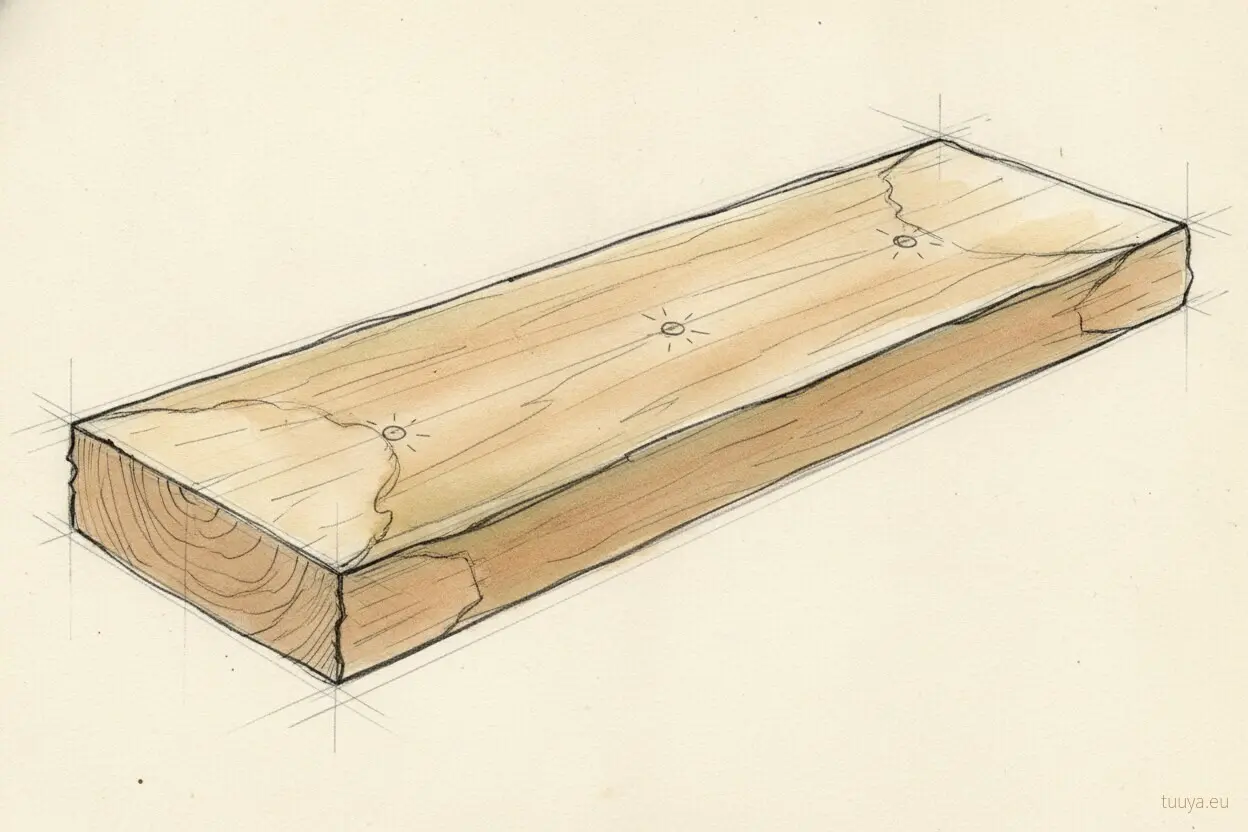
Erected timber frames and when a moisture reading is worth asking for
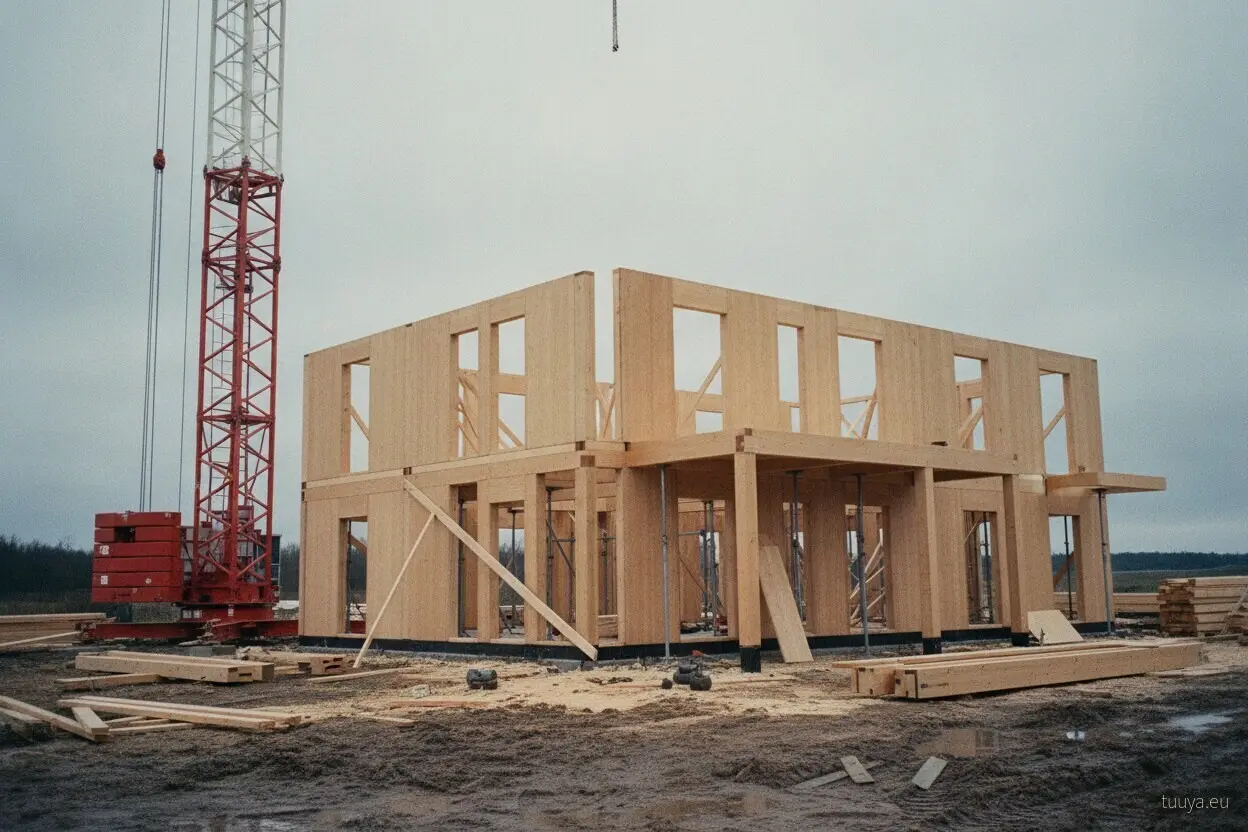
On light timber-frame sites, the erected structure usually goes up without a moisture survey. A missing reading does not, on its own, say anything about the quality of the work.
Frame timber is bought as graded, dried material, and its condition is taken from the supply documentation. Ask for a measurement when the structure has stood in wet weather before the shell is closed.
Rain during erection is its own subject, and how a rained-on panel or a wet frame dries out deserves more room than a reference table gives it.
Moisture content and wood decay: why there is no single threshold
No single moisture reading marks the point where wood starts to rot. Fungal decay needs moisture sustained over time, together with suitable temperature and oxygen. A spot reading on delivery cannot tell you whether decay will begin.
What a specifier controls is how long the timber stays wet and whether the assembly lets it dry. Both are settled in the drawings and in the sequence of work on site.
If delivery readings come in above the figure in the supply contract, record each one with its stage, method and date and send them to the supplier and the structural engineer. Ask both to confirm in writing whether the material can be built in as delivered, or what drying it needs first.