Kit, Shell or Turnkey: Choose the Scope of Delivery You Can Manage
Three offers for the same house are rarely three prices for the same thing. One covers numbered panels on a truck. One covers a building that can stand in the rain with the windows in. One covers a house you can lock behind you on the day you move in. Comparing those bottom lines before you have settled the scope of delivery is comparing nothing, because the scope decides which trades stay on your side of the line and who spends the next nine months on the phone.
Our position: if you are building your first house, at a distance from the plot, with a full-time job, buy the weathertight shell and contract the fit-out locally. The kit belongs to buyers with real construction experience, or a builder they have already worked with and trust. Turnkey belongs to buyers whose own working time is worth more than the coordination would ever save them.
Our interest here is easy to see. We design and manufacture solid timber homes in MHM and CLT, A-frame kits, glulam structures and saunas in Latvia and deliver across Europe, so what we make sits inside all three scopes. We do not sell groundworks, heating installation or interior fit-out, and none of this is written to move you toward buying those from one hand.
Where the manufacturer stops and you start
The word shell travels badly between countries, and between two suppliers on the same street. Read every offer for its own boundary. What follows is the common trade meaning, not something you can hold anyone to.
A kit is the engineered structural package: wall, floor and roof elements or A-frame components, cut, numbered and delivered, normally with the structural drawings and an assembly sequence. Erection, crane, foundation, roof covering, windows and everything after them are yours to procure. The same wall panel that goes into our solid timber houses can arrive as a numbered kit or as part of an erected shell. The panel does not change. The responsibility does.
A weathertight shell normally means the structure erected on your foundation, roof covering on, windows and external doors fitted, so the building can be closed and dried. This is the term that varies most, so ask item by item what sits inside it:
- the roof covering itself, or only a structural roof with a temporary membrane over it
- external doors as well as windows
- insulation, where the wall and roof build-up calls for it
- external cladding, and the scaffolding it needs
Turnkey means one contractor carries the programme through to handover: services, screeds, internal finishes, connections. You still carry the permit, the site, the decisions, and the cost of every change you make after work has started.
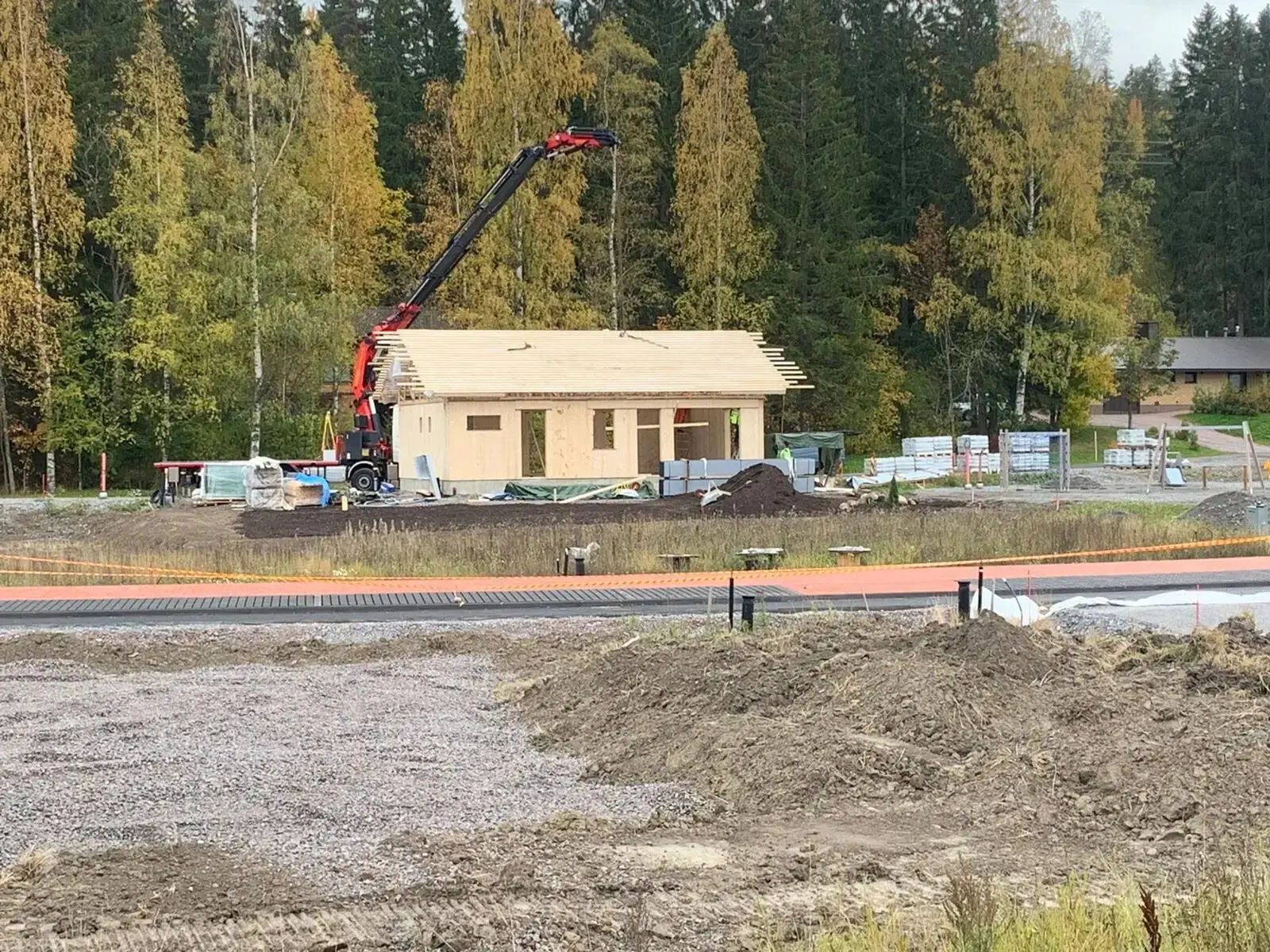
Time on site is the first thing a scope of delivery buys
A kit makes you the general contractor, whether or not you use the words. The job you have bought yourself runs roughly like this:
- groundworks and the foundation, designed for your ground and your building
- crane day and erection, booked into somebody else's calendar
- roof covering, before the weather turns
- windows and external doors, so the building can be closed and dried
- first fix electrics and plumbing, cutting through work already done
- linings, screeds and finishes, in the order the drying allows
Every gap between two of those lines is yours to close. Every question a foreman asks at half past seven in the morning is yours to answer by nine, because a crew standing about is a crew invoicing you. That work is real even when you do none of it with your hands.
So count the hours before you buy the saving. A couple both working full time, with a plot three hours away and two young children, will not run a site through weekly evening calls. They can run a shell contract with monthly visits and a local fit-out contractor. They cannot run a kit without taking leave, and pretending otherwise is how a build ends up sitting open through November.
The saving is real, and it is paid in attention
Money moves toward whoever takes the risk and does the chasing. Buying a kit and organising the rest yourself takes a contractor's margin and overhead out of a large part of the job, which is exactly why the headline figure looks so good on a Sunday evening. It does not take out the work that margin paid for, and it does not cover the cost of the decisions you get wrong the first time you make them.
The trades within reach of your plot
Scope should follow the local labour market rather than the brochure. If you can already name the electrician, the plumber and the joiner who will turn up in your region, and you have stood in a house they finished, more of the job can safely stay in your hands. If you cannot name one of them, you are proposing to run a procurement exercise in a market you do not know, from a distance, often in a second language.
Some of the work stays local whatever you decide. The foundation follows from a survey of the specific plot and from the loads of the actual building. A solid timber wall of comparable size usually puts higher loads on the foundation than a light frame one, and the figures that matter come from the structural design. That design belongs to your ground and your structure rather than to a template. Access, craneage and the shape of the building shift the total as much as any material choice, which is the subject of what really moves the price of a timber house.
Money, permits and insurance follow the contract you sign
Staged construction lending pays against work standing on the plot. A factory package is largely paid for before it reaches the plot at all, and those two rhythms do not line up on their own. Ask your lender directly how they treat prepayments for off-site manufactured elements before you choose a scope of delivery. The answer sometimes settles the question by itself.
Permits run on their own calendar and sit outside all three scopes: changing the delivery scope does not remove the planning and building-control requirements that apply to the plot. The structural and architectural documentation has to be resolved before manufacturing is released, whichever package you buy, and no scope shortens an authority's review.
Insurance is the quiet one. While a building is open to the weather, somebody insures the works, the delivered materials and the people on site. Under a turnkey contract that is normally the contractor's business. On a kit build it is yours, from the moment the truck is unloaded.
Who owns the joints between packages
Split scopes fail at the joints, not in the middle of a trade. Airtightness is the classic case: one company installs the layer, another drills through it for cables and pipes, and the question of who repairs and verifies it has to be answered in writing before either of them starts. The wall, roof and floor junctions are where a warm house is won or lost, band by band, as set out in the junctions where winter heat is really lost.
Turnkey buys you a single address for that question. A kit or shell contract can work every bit as well, on one condition: the handover point is defined. What condition the building is in when it changes hands, what is protected and how, and what the follow-on trade is expected to inspect before covering anything up.
| Criterion | What it actually asks of you | Where it points |
|---|---|---|
| Hours available each week | Answering site questions, ordering, sequencing, inspecting | Few: turnkey. Some: shell. Many: kit |
| Distance to the plot | Travel time for every visit and every problem | Far away: shell or turnkey |
| Trades you can already name | A plumber, electrician and finisher who will actually come | Named and trusted: kit or shell |
| Payment and drawdown pattern | Matching factory prepayments to staged lending | Confirm with the lender before signing |
| Ownership of airtightness and moisture details | One contract across the layers, or a written handover | Split scope needs the interface documented |
| Tolerance for delay and weather risk | Absorbing rescheduling and idle trades yourself | Low tolerance: turnkey |
When the kit is the right call
The kit is the right purchase more often than a cautious version of this article would admit. It suits buyers who have built before, buyers with a builder they have already worked with, and anyone building something small enough to hold in their head: a sauna, a cabin, a compact A-frame. It also suits people who would rather spend across two or three seasons than in one continuous programme, closing the building first and finishing rooms as money allows.
There is a second case that has nothing to do with skill. On a remote plot, or where a contractor would have to house and move a crew a long way, the coordination premium can outweigh what a locally self-managed build costs, even once you have put a price on your own time.
Two conditions come with that choice. Solid timber elements are heavy, so crane position, ground bearing for the machine and delivery access are planned before anything is ordered, and erection is not a weekend with friends and a borrowed trailer. The second is drying: the building needs to be closed within a sensible window, because a structure standing open through a wet autumn creates work nobody put in the budget. Walking through buildings that have already been delivered in different scopes teaches more in an afternoon than a spreadsheet does in a month.
The verdict
Buy the smallest scope of delivery you can genuinely manage, and be hard on the word genuinely. For an experienced builder, that is the kit, and the saving is earned rather than gifted. For someone building once in their life, it is the weathertight shell: the structural and weather risk sits with a manufacturer who does it repeatedly, while the fit-out stays local, visible and easier to price and phase.
Turnkey is not the lazy option. It converts money into removed risk, and for a buyer whose working time is expensive, or who is building in a country they do not live in, that is a rational trade. The mistake worth avoiding is picking a scope from the bottom line of a comparison and finding out in month four that the cheapest package quietly hired you as project manager.
Frequently asked questions
Can I buy a kit now and add erection or more services later?
Usually yes, but the moment to decide is before manufacturing, not after delivery. Erection crews and cranes are booked into a calendar weeks ahead, and a package that lands on site without a confirmed erection date starts costing storage, protection and rescheduling. Ask what the latest sensible point is to extend the scope, and get that date written into the contract.
Who is responsible if the structure gets wet before it is closed in?
Whoever holds the site at that moment, which is precisely why the contract has to name the handover point and the day it takes effect. Timber tolerates a limited amount of construction moisture, provided the exposure is controlled and the structure can drain, ventilate and dry out again. Standing water, unprotected end grain and long open periods make work. Agree in writing who protects the building, from which day, and who signs it off before anything is closed up.
Does a split scope make warranty claims harder?
It makes them more specific rather than harder, as long as the boundaries were documented. With one turnkey contractor there is one address for every defect. With a kit or shell plus local trades, a defect has to be traced back to a package, so keep the drawings, the delivery records and photographs of every junction before it disappears behind a lining, and note who signed off each handover.