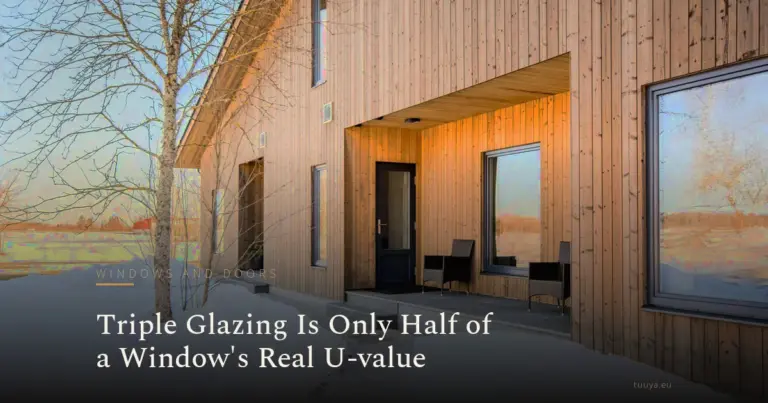
A Wooden Entry Door Is Judged by Its Frame, Not Its Face

In short: A wooden entry door is judged by its frame, its seals and the way it is fixed into the wall, not by the species on the face or the number of locking points listed in the brochure.
Entrance doors tend to be specified late, once the walls, the windows and the heating have been settled. By then the opening is cut, the budget is whatever is left, and the conversation narrows to a leaf, a colour and a lock. Five claims come up in almost every one of those late conversations, and each carries a grain of physics that has been stretched too far.
"A solid slab of oak is the best door money can buy"
Hardwood makes an excellent door face and a demanding door leaf. Wood changes dimension with moisture, and the movement is much greater across the grain than along it. An exterior door has a warm, dry side and a colder, damper one, so the two faces of a leaf are never at the same moisture content. That difference through the thickness is what cups and twists a wide, one-piece slab until it binds at one corner in one season and shows a line of daylight in another.
Traditional joinery answered this with frame-and-panel construction: narrow stiles and rails around panels that are free to move in their grooves. Modern joinery answers it with an engineered leaf, stiles laminated from several pieces with grain deliberately alternated, and a symmetrical build-up around an insulating core so both faces react to humidity in a similar way. Both are honest timber construction, and neither is a plank.
So judge the construction and not the species. Oak, larch and thermally modified softwoods all make good exterior leaves when the leaf is built to stay flat, and a badly built leaf in a prestigious timber still moves. The overview of wooden doors sets out where each type belongs.
"A wooden entry door cannot be as warm as an insulated composite one"
An insulated timber leaf and a composite leaf are far closer than the marketing suggests, because both are mostly insulation behind a facing. Timber conducts heat poorly by nature, which is why a timber-faced leaf does not depend on the thermal breaks that a steel- or aluminium-skinned leaf needs to avoid a cold line straight through the door. A GRP composite leaf does not have that problem either, which is exactly why the comparison has to move to the perimeter.
The heat does not usually leave through the middle of the leaf. It leaves at the threshold, at tired or badly compressed seals, around any glazed insert and its spacer, and through the joint between frame and wall. That is the same gap you meet with glazing, where the glass figure is not the window figure, and it applies to doors just as directly.
Compare the declared thermal performance of the complete doorset, not a core panel figure, and where a U-value is quoted, check exactly what it refers to: the panel, the frame or the whole doorset, which is the figure declared under EN 14351-1. Then ask the separate question that no datasheet answers: how the perimeter joint will be insulated and sealed once the door is in the wall. A small difference in the declared number matters less than a draught you can feel with your hand.
"Multi-point locking is what makes a door secure"
Multi-point locking is worth having, and it is one link in a chain. Bolts or hooks engaging at several heights spread the resistance along the leaf, make levering harder and help hold a tall leaf against the seals, which is a comfort benefit as much as a security one.
The rest of the chain decides the outcome. The cylinder and its protective escutcheon resist drilling and snapping; hinge bolts on the hinge side stop the leaf from being lifted out once the hinges are attacked; strike plates need long fixings that reach real structure, not just the lining; the frame itself has to be anchored to the wall so the whole set works as one. Glazing within arm's reach of the handle changes the calculation again.
European burglar-resistance classes under EN 1627 run from RC1 to RC6, with RC2 and RC3 the usual domestic range, and they apply to a tested doorset in a defined configuration, so the frame, leaf, locking hardware and installation detail all have to match the construction that was tested. A high-grade lock on its own does not give an ordinary door the same class. We do not make locks or cylinders, so we have no stake in which brand ends up in the leaf; we only care that the frame around it is fixed the way the tested set assumes.
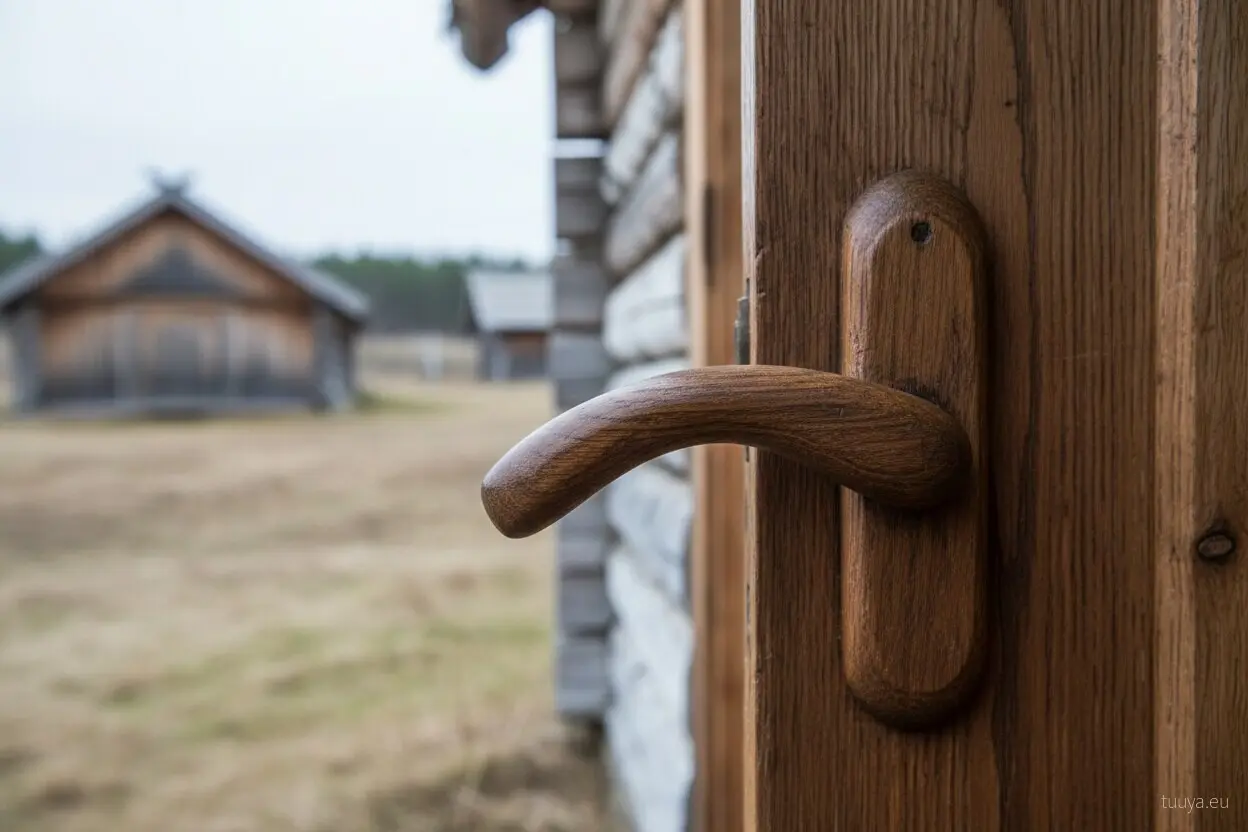
"A good oil finish means no maintenance for years"
An exterior finish is a consumable, and its life is set by exposure rather than by the tin. Ultraviolet light breaks down the surface, driving rain loads it with water, and a south or west elevation with no shelter works the coating far harder than a recessed north entrance. Two identical doors on the same house can need recoating on completely different cycles.
Pigmented and opaque finishes hold up longer than clear ones because the pigment blocks the light that degrades the film. The bottom rail and any exposed end grain are the first places to look, since end grain wicks water along the grain far faster than a face does. Recoating while the film is still intact is a light job; recoating after it has failed means stripping back and sometimes repairing.
The cheapest protection is geometry, decided before the door is ordered. A canopy, a recessed reveal, a threshold with a proper drip and a flashed sill keep weather off the face, and it is worth looking at how entrances are sheltered in built projects; catalogue photographs taken in dry weather show none of this.
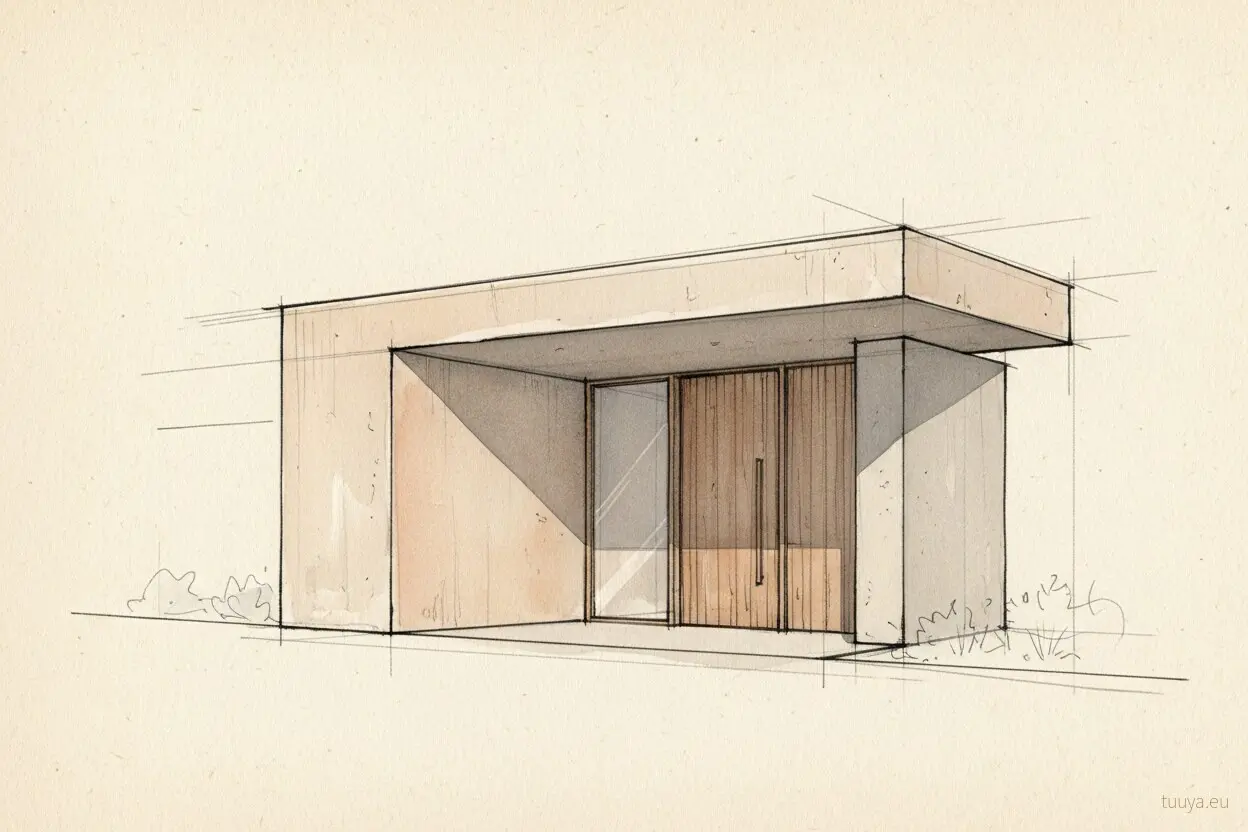
"The door is a product; fitting it is just carpentry"
Fitting is where a good door set is won or lost. The frame has to be plumb, square and packed so that fixings transfer load into the structure rather than pulling the frame out of shape, because a frame twisted by a few millimetres will not compress its seals evenly and the leaf will leak air at one corner until somebody takes the frame out and re-fits it.
The perimeter is a small assembly of its own: insulation in the gap, a weather-resistant seal outside, and an air seal inside. In a cold-climate build-up the airtight layer usually sits towards the warm side of the reveal, and the build-up should be verified for the whole assembly and the local climate instead of being copied from a detail drawn for somewhere else.
What the wall behind the frame changes
Solid timber walls are not all the same in this respect. A stacked log wall (blockhaus construction) settles measurably over its first few years, so entrance frames are traditionally fitted in a settlement channel with a gap above that lets the wall come down without loading the frame. Panelised solid timber such as MHM (Massiv-Holz-Mauer) or CLT settles far less than a stacked log wall, but the reveal detail, the fixing pattern and the allowance for movement still belong on a drawing ; improvising them on site is where this goes wrong.
Finally, settle who does this work before you sign. Supply-only, supply and fit, and fit including the finished reveal are three different prices, and it is worth checking which side of the scope line the fitting sits on in every quote you compare.
What this comes down to: Buy a door set rather than a door. Leaf construction, whole-door U-value, frame anchorage, seals and the fitting detail are one purchase, and the weakest of them sets what you get.