A-frame house problems, and how a good kit avoids them
The real A-frame house problems are sloped walls that eat floor space, less daylight through the roof sides, insulation that has to live in the rafters, and a first floor that needs careful planning. None is fatal. All of them are solvable at the design stage, and far cheaper there than on site. Here is the honest list, from people who engineer A-frame kits for European sites.
Half of what ranks for this question is not even about A-frames; it is about ordinary timber-frame houses. So let us talk about the actual triangle.
Sloped walls really do cost you floor space
In an A-frame, the roof is the wall. That means the gross floor area is not the same as the stand-up area. On a small footprint the loss is felt at the edges of every room: beds, desks and wardrobes want vertical walls.
What fixes it is deliberate planning, not optimism. Low zones become storage, benches and bathtubs. The stand-up zone stays in the middle. Our A-frame house kits run from 30 to 90 square metres, in one or two storeys, and the floor plan is drawn around this geometry from day one. An A-frame is a roof you live inside; treat it that way and it works.
Daylight has to come from the two gable ends
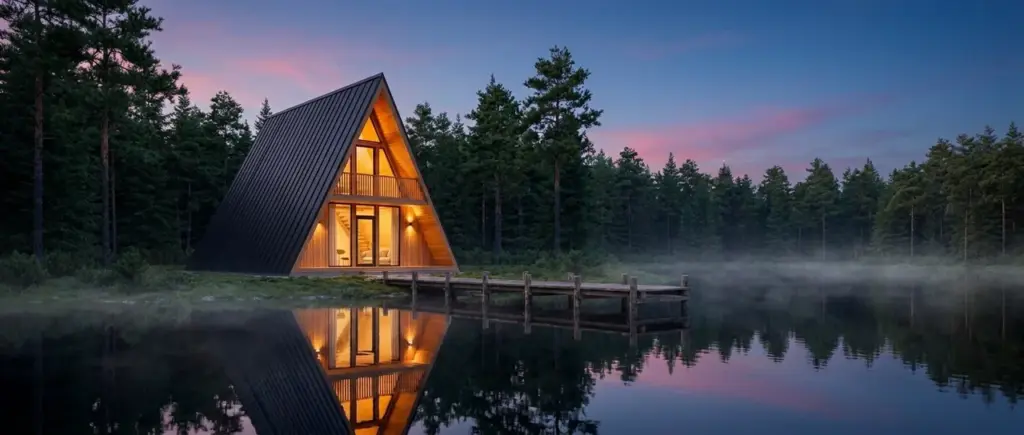
The long sides are roof, so the natural places for glass are the two gable ends. Done lazily, that means a bright living room and a dim middle.
The answer is a big glazed gable to the view, roof windows over the darker zones, and a floor plan that puts daytime rooms at the glass. This is standard practice, not invention, but it has to be decided before production, because openings in a structural roof are engineering, not decoration.
The roof is also the insulation, so the build-up is everything
A four-season A-frame lives or dies in the rafter build-up. The slope is the envelope: insulation thickness, airtightness and ventilation all sit in that one sandwich. Skimp there and the house is a summer cabin with winter bills.
This is where a kit either earns its money or does not. Our kits are engineered as proper insulated houses for year-round living, not festival cabins. Ask any kit supplier, including us, one question: show me the roof section, layer by layer. The answer tells you everything.
The upper floor is a triangle too
Upstairs the geometry tightens. Headroom is generous at the ridge and gone at the sides, so the first floor works as a sleeping loft, a study or a children's level, not as a second ground floor. On 30 to 90 square metres you plan one full storey plus a clever one, and the house feels larger than its floor area suggests.
An A-frame is a niche shape, and that is fine
Be clear-eyed about this one. An A-frame photographs beautifully, sheds snow very well and encloses volume with very little material. It is also a specific way to live. If you need four bedrooms, straight walls everywhere and a formal dining room, the triangle is the wrong tool; a compact solid timber house will serve you better, and we will say so before you spend a deposit.
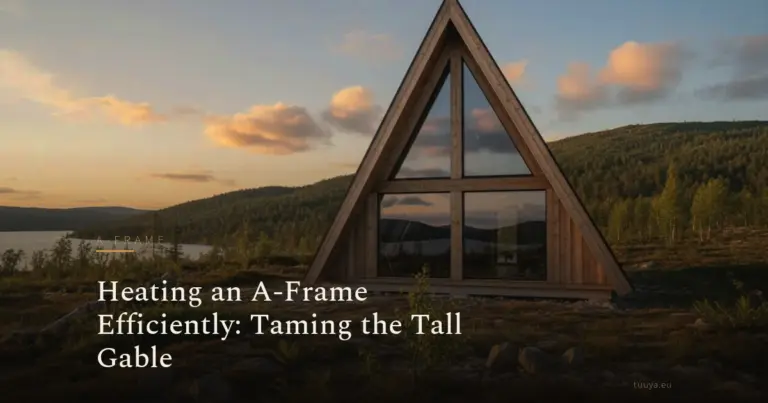
But as a lake house, a mountain cabin or a small full-time home for one or two people, the A-frame is a strong choice when character, compact planning and fast assembly matter. The steep pitch that clears snow so well is a feature, not a compromise, in the mountains where these houses look most at home.
Two A-frame house problems that are not real
Structure: a properly engineered A-frame is a set of braced triangles, one of the most stable shapes you can build. Our kits take their snow and wind loads from Eurocode 1 and design the timber and its connections to Eurocode 5, for the specific site, not for a brochure. Lifespan: the frame is ordinary structural timber, and with the roof and flashings doing their job it lasts as long as any well-built wooden house. The timeline is realistic too: one to three months of design, one to two months of production, and one to three weeks of assembly on a prepared foundation, weather and crane access permitting.
What buyers ask before they order
What is the biggest disadvantage of an A-frame house?
Usable space. The sloped sides reduce stand-up area, so an A-frame needs a floor plan drawn for the triangle. Storage in the low zones and living in the middle solves most of it.
Can you live in an A-frame all year in Europe?
Yes, if the roof build-up is engineered for it: proper insulation thickness, airtight layers and ventilation. That is the difference between a house kit and a summer cabin kit.
How long does an A-frame house last?
As long as any well-built timber house. The structure is ordinary graded timber; kept dry at the junctions and roofed properly, that is a lifespan measured in generations, not decades. Our materials carry a 5 to 10 year guarantee, and the frame is built to outlast it.
Are A-frame houses cheaper to build?
Often, per enclosed volume, because the triangle encloses space with little structure and goes up fast. But glazed gables and roof windows are where budgets grow, so we price each kit individually and the number you get is for your version, not a teaser.
Is an A-frame house solid timber?
No. An A-frame is a timber frame structure by nature. If you want massive glue-free walls, look at our MHM solid timber houses instead; if you want the triangle, we build it as a proper insulated frame.
Decide with a drawing, not a mood board
Every A-frame house problem above is cheap to fix in the drawing and expensive to fix on site. Show us where you build and how you want to live in the triangle, and we send back a floor plan, a roof section and a price for your version. The configurator is the fastest way to sketch yours; a note to our project team works just as well.